
Fast Healthcare Interoperability Resources (FHIR)
FHIR is the HL7 standard for exchanging healthcare data electronically, simplifying data sharing and improving patient care across connected systems.
Fast Healthcare Interoperability Resources (FHIR) is a modern standard for exchanging healthcare information electronically. Health Level Seven International (HL7) built it to make sharing data between healthcare systems easier, and ultimately to improve patient care. Because it's built on current web standards and technologies, FHIR slots into existing systems and new ones alike without a painful integration effort.
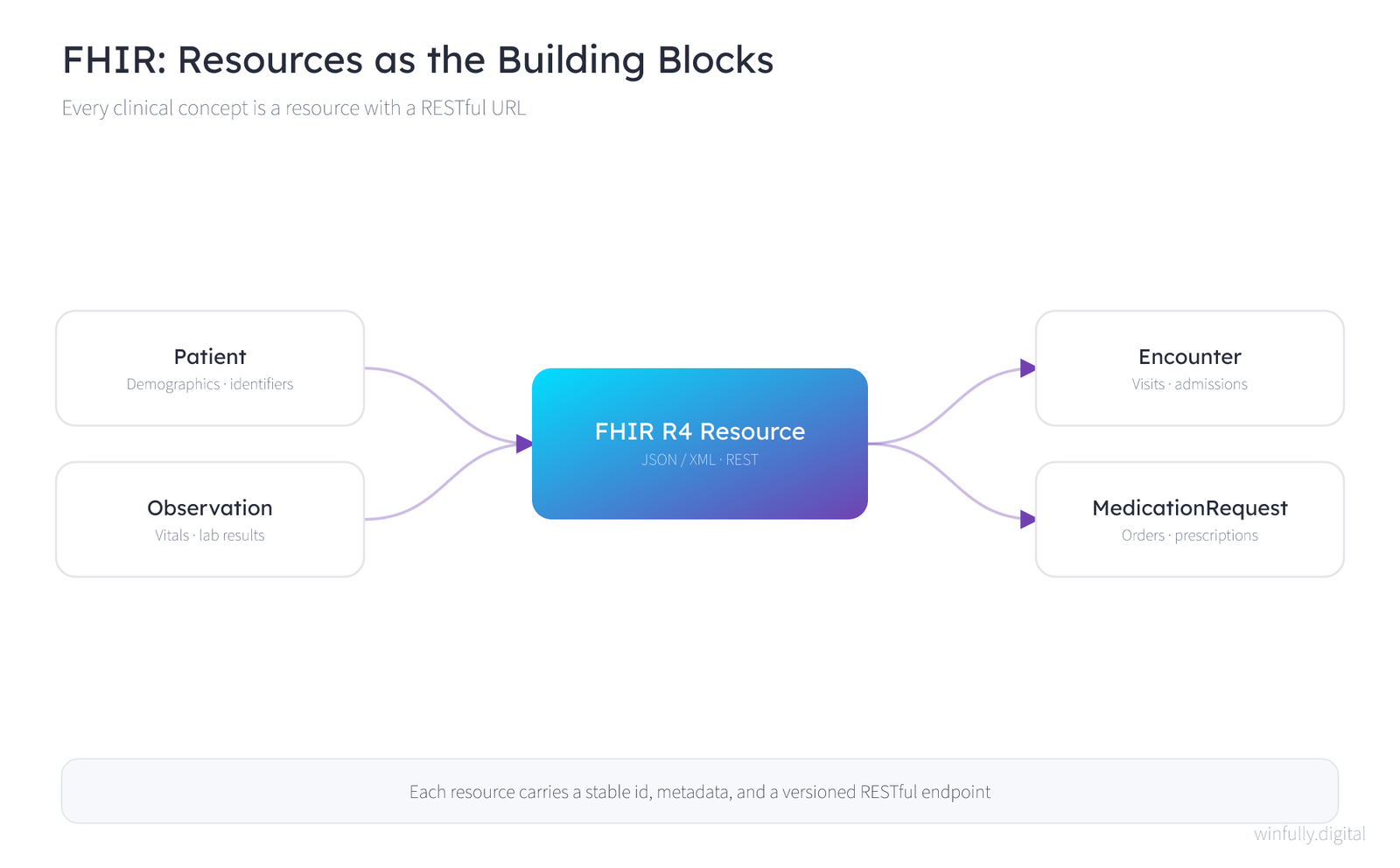
FHIR models healthcare concepts, such as patients, conditions, medications, and observations, as "Resources." Those Resources line up with existing healthcare data standards, drawing on the HL7 Clinical Document Architecture and HL7 v2 formats. And because the standard is both adaptable and scalable, it fits a wide range of settings: hospital systems, primary care, specialty practices, and even national and global health programs.
FHIR fundamentals
At its core, FHIR is a data-exchange standard from HL7 designed to simplify sharing between healthcare systems and improve patient care. Here's what makes it tick:
- Resources: FHIR defines a set of data exchange models, called "Resources," that represent common healthcare concepts like patients, conditions, medications, and observations.
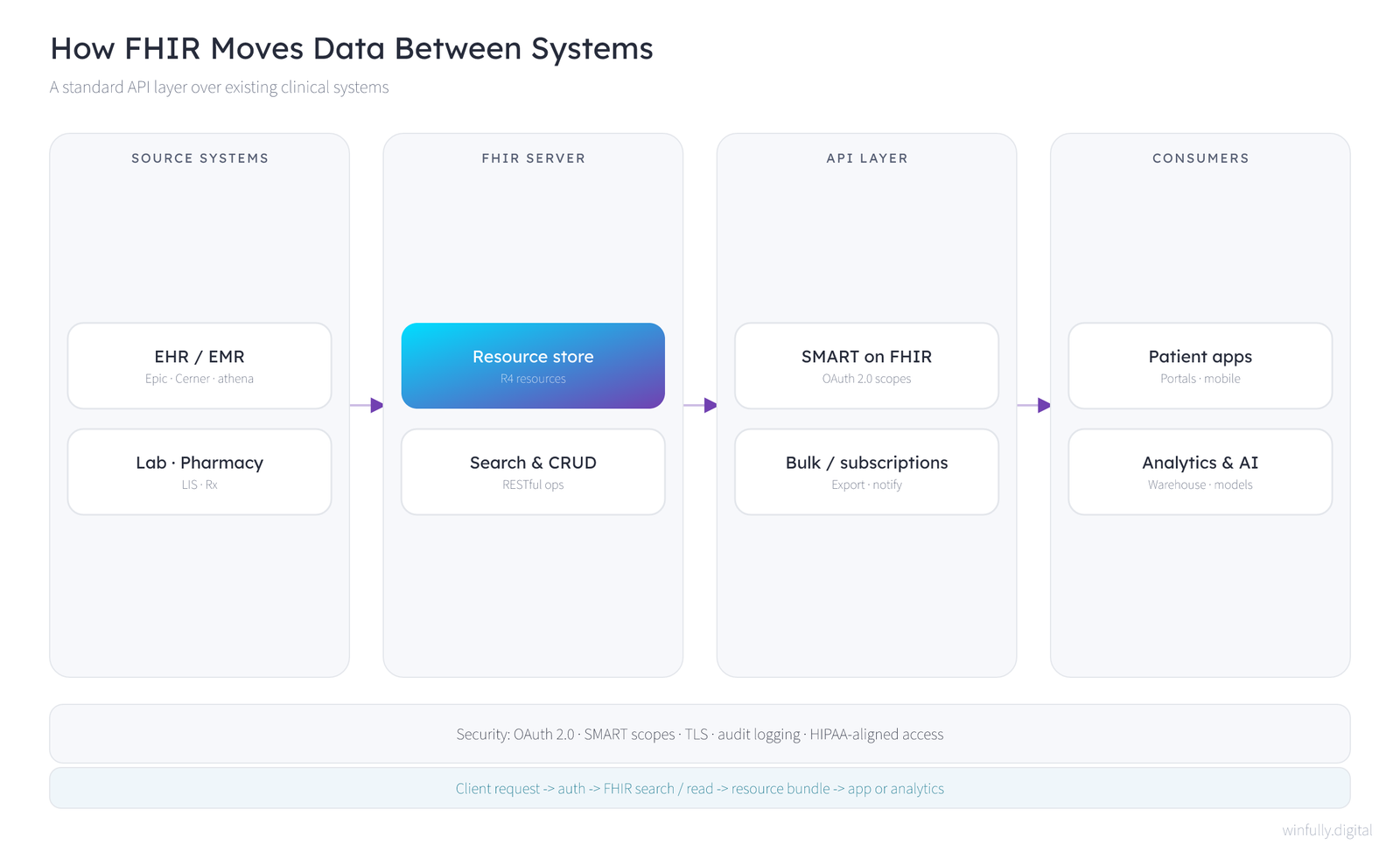
- RESTful API: FHIR uses a RESTful API (Application Programming Interface) to exchange data between systems, allowing systems to exchange data in a standard way.
- XML and JSON: FHIR supports both XML and JSON data formats, allowing systems to choose the format that is most appropriate for their needs.
- Open Source: FHIR is an open-source standard, allowing healthcare organizations and developers to freely use and contribute to the standard.
- Continual Improvement: FHIR is designed to be a living standard, with ongoing development and improvement to meet the changing needs of healthcare.
- Implementation Guides: FHIR provides detailed implementation guides for developers to follow, making it easier for organizations to adopt the standard and ensure consistency in implementation.
- Extensibility: FHIR is designed to be extensible, allowing organizations to add their own custom extensions to the standard to meet their specific needs.
- Interoperability: FHIR is designed to promote interoperability between different healthcare systems, allowing systems to exchange data in a standard way and improve the quality of care for patients.
The payoff shows up in a few concrete ways. FHIR gives every system the same set of data-exchange models, which cuts the time and cost of building integrations and makes sharing data far less of a project. It improves care, too: when patient data is easy to access and share, there's less room for error and less wasted effort. And it does this securely, with features like access control and data encryption built in rather than bolted on.
Examples
Boston Children's Hospital uses FHIR to move patient data securely between systems, which improves care and cuts down on errors. On a national scale, the government of Canada is building a health information exchange platform on FHIR so providers can share patient data safely across the country.
The University of Colorado Anschutz Medical Campus is another good example, using FHIR to exchange patient data across systems with the same gains in care quality and accuracy. And like Canada, the government of Australia is using FHIR as the backbone of a national health information exchange for secure provider-to-provider data sharing.
Benefits of FHIR
FHIR brings a lot to the table for healthcare organizations. The main benefits:
- Simplified Data Exchange: FHIR provides a standard set of data exchange models that can be used by all systems, reducing the time and cost of implementing data exchange and making it easier for healthcare organizations to share data.
- Improved Patient Care: FHIR makes it easier to access and share patient data, reducing the risk of errors and improving the quality of care for patients.
- Secure Data Exchange: FHIR provides a secure way to exchange data, with security and privacy features like access control and data encryption.
- Flexibility: FHIR is a flexible and scalable standard, making it suitable for a variety of healthcare scenarios, from hospital systems to primary care and specialist systems, and even for global health initiatives.
- Adoption and Support: FHIR has a strong community of support and adoption, with many healthcare organizations and electronic health record (EHR) vendors implementing support for FHIR in their systems.
- Integration: FHIR is based on the latest web standards and technologies, making it easy to integrate with existing systems and new systems being developed.
- Improved Efficiency: By making it easier to access and share patient data, FHIR can help improve the efficiency of healthcare organizations and reduce the risk of errors.
- Compatible with Existing Standards: FHIR is based on the HL7 Clinical Document Architecture and HL7 v2 data exchange standards, making it compatible with existing healthcare data standards.
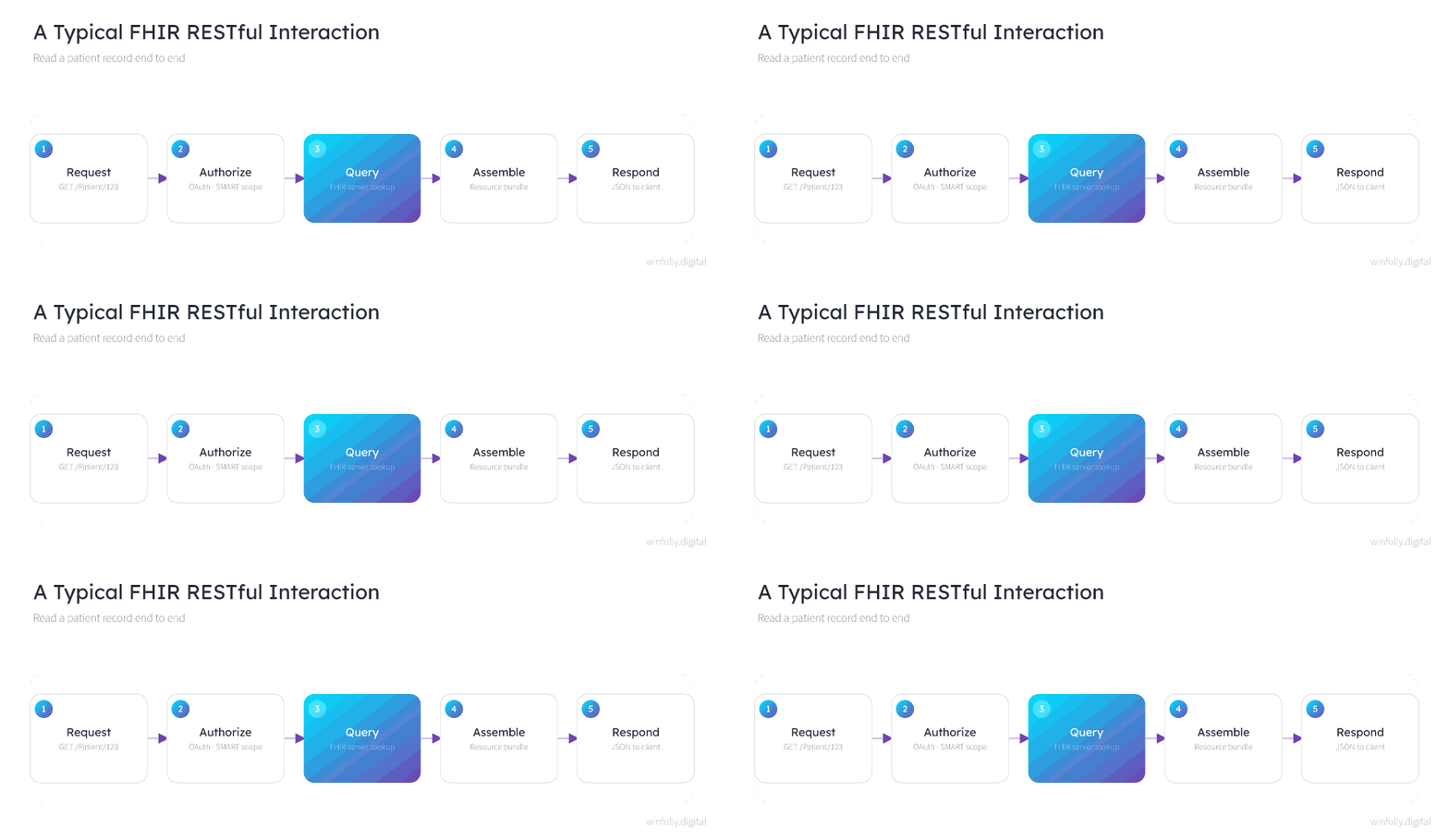
The animation below traces a typical FHIR RESTful interaction, from the client request through to the JSON response:
At WinFully Information Systems, we're a healthcare IT consulting firm, and we help organizations adopt FHIR and get real value out of it. Our team has deep hands-on experience with the standard and can handle implementation, integration, and ongoing support. If you're trying to improve how you exchange healthcare information, FHIR is worth a serious look, and we'd be glad to help.
Adoption is on your side here. FHIR has a large, active community, and most major EHR vendors, including Cerner, Epic, and Allscripts, have built support for it into their systems and keep making data exchange easier through it.
FHIR is a genuinely valuable standard for healthcare information exchange. It plays well with existing data standards, integrates without heavy lifting, handles security, and stays flexible enough for almost any setting, which is exactly why it keeps gaining ground and will shape how healthcare shares data for years to come.