
AI in Drug Discovery: Cutting Costs and Accelerating Timelines
How AI and machine learning are transforming pharmaceutical drug discovery, cutting development costs, accelerating timelines, and improving success rates.
Life science and pharmaceuticals have always balanced three competing pressures: scientific innovation, regulatory rigor, and heavy financial investment. Whether the product is a small molecule, a biologic, or a gene therapy, the road from concept to market can run more than a decade and cost billions. That road has a name — the drug development pipeline — and it moves through target identification, lead compound discovery, preclinical studies, and clinical trials before anything reaches regulatory approval.
Artificial intelligence (AI) and machine learning (ML), now joined by large language models (LLMs), are reshaping every one of those stages. Applied to molecular screening, protein structure prediction, toxicity assessment, and clinical trial design, these tools let companies cut both the time and the cost of getting a new drug to patients.
This article walks through where AI and ML are making the biggest difference across drug discovery — how they compress timelines, where the savings actually come from, and what that means for the organizations building this capability.
The Traditional Drug Discovery Challenge
It helps to be clear about what makes traditional drug discovery so hard:
-
High costs: Bringing a single new medication to market can cost upwards of $2.6 billion once you account for discovery, clinical trials, and post-market surveillance.
-
Long timelines: From first research to FDA approval, the process can span 10 to 15 years. Every stage — discovery, preclinical testing, clinical trials, regulatory review — is slow and resource-hungry.
-
High failure rates: Fewer than 10% of compounds that enter phase I trials make it to approval. The rest represent sunk costs, and many fail late, after safety or efficacy problems surface deep into development.
-
Data overload: Scientific literature and datasets grow faster than any team can read them, so relevant findings routinely go unnoticed.
AI, ML, and LLMs give pharmaceutical and life science organizations a way to push back on all four. Here is how that plays out stage by stage.
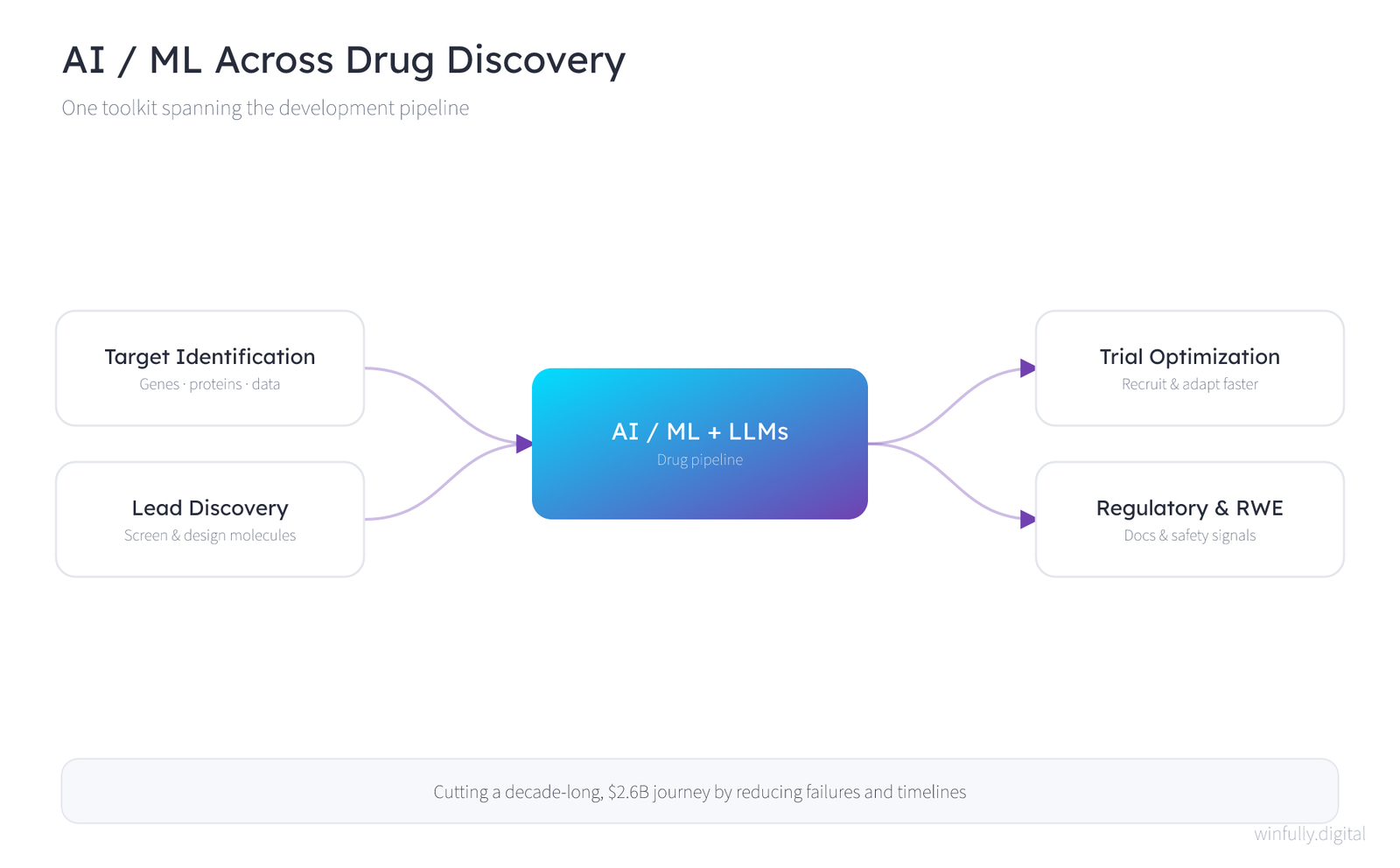
How AI/ML Is Transforming Drug Discovery
Target Identification and Validation
Drug development starts with finding the biological target — usually a protein or gene central to a disease. AI and ML can sweep through genomic and proteomic data alongside the published literature to surface the targets worth pursuing.
Biomarker discovery: ML models spot patterns in large patient datasets, flagging biomarkers that track with disease progression or drug response. That sharpens target selection early.
LLM-assisted literature review: An LLM can read thousands of publications in minutes and hand back the studies that actually matter for a given target or disease, so researchers reach data-driven decisions faster.
Business impact: Get target selection right at the start and you avoid a chunk of late-stage failures — the ones that cost millions of dollars and years of work.
Lead Compound Discovery
With a target in hand, the next job is finding a lead compound that binds to it well. The traditional answer was high-throughput screening (HTS): test thousands or millions of compounds against the target, at real expense and over real time.
-
In silico screening: AI models predict how a chemical entity will bind before anyone touches a pipette. Focusing wet lab work on the most promising candidates cuts the number of physical experiments sharply.
-
Generative drug design: Deep learning can generate novel molecular structures aimed at a specific target, weighing physicochemical properties, ADME (absorption, distribution, metabolism, excretion), and toxicity as it goes. The result is a set of candidates more likely to hold up.
-
LLM-powered search: An LLM can query chemical databases, patent repositories, and the literature to find existing compounds or analogs already showing promise, which spares teams from rediscovering what is already known.
Business impact: Screening gets cheaper and the path to a strong lead candidate gets shorter — and lead identification is one of the most time-consuming phases in the whole process.
Optimization and Validation
A promising lead still needs extensive optimization to land the right balance of efficacy, selectivity, and safety. That work traditionally means round after round of synthesis and testing, which pushes costs and timelines up again.
-
Predictive modeling: ML can predict how a small change to a chemical structure will shift its binding affinity, solubility, and toxicity, so chemists modify with intent instead of by trial and error.
-
Toxicity screening: Catching toxicity early prevents expensive failures later in the clinic. AI models compare a candidate's structure against known toxic compounds and flag the high-risk ones before they advance.
-
Automation and robotics: Paired with AI-driven decisions, robotics handles repetitive steps like compound synthesis and assay testing, raising throughput and cutting human error.
Business impact: Tighter optimization means a higher success rate in preclinical development, fewer late-stage failures, and real savings in both time and capital.
Pre-clinical and Clinical Trial Streamlining
Even a well-optimized compound faces its real test in preclinical studies and clinical trials. These stages prove safety and efficacy in living systems, and they eat up a large share of the total timeline.
-
Animal model analysis: ML can predict which animal models will yield the most relevant data for a given disease, so results translate more cleanly to human trials.
-
Patient recruitment: AI can search electronic medical records (EMRs) and patient databases to match participants against genetic, demographic, and medical-history criteria. Recruitment is often the biggest bottleneck in a trial, and this cuts it down.
-
Adaptive trial design: ML supports adaptive trials, where data from an ongoing study is analyzed as it comes in to adjust dosing or group patients into the subsets most likely to respond. That trims the number of subjects needed and gets to conclusive results faster.
-
Remote monitoring and digital endpoints: AI-enabled wearables and mobile apps track patient vitals continuously and feed back real-time data. Teams get a clearer picture of patient response, and the logistics get simpler, which opens the door to decentralized and hybrid trial models.
Business impact: Applying AI across preclinical and clinical work shortens development time, lowers patient dropout, and puts resources where they matter — savings that run into the millions for life science organizations.
Regulatory Compliance and Post-Market Surveillance
Once trials succeed, regulatory approval is the next milestone — and the work does not stop there. After approval, companies still owe close attention to pharmacovigilance and post-market surveillance, tracking adverse events and real-world effectiveness.
-
Automated documentation: LLMs can draft and review regulatory submissions, easing the load on compliance teams. Automating Common Technical Documents (CTDs) and similar filings removes a lot of administrative overhead.
-
Safety signal detection: AI can comb patient reports, medical records, and social media for early safety signals and adverse events. Catching them quickly lets teams manage risk before it grows and stay compliant.
-
Real-world evidence (RWE): ML can analyze electronic health records, insurance claims, and patient-generated data to judge a drug's long-term efficacy and safety, which feeds back into labeling and usage guidance.
Business impact: Handling compliance well heads off costly recalls, litigation, and reputational damage — and protects long-term profitability.
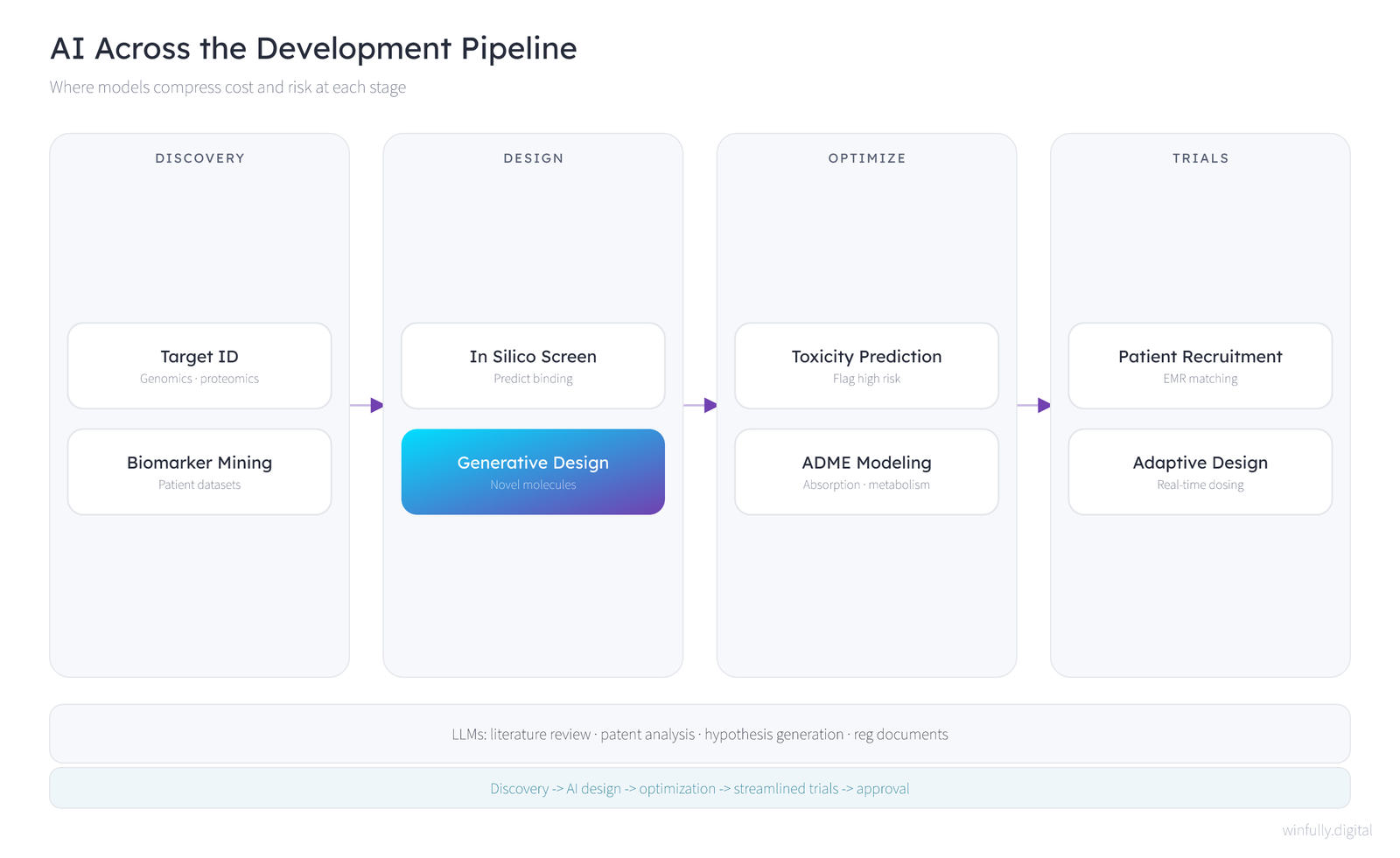
The Role of Large Language Models (LLMs) in Drug Discovery
Most AI and ML work in this space runs on numerical and image-based data. LLMs — GPT-style architectures — add something different: they work with language, which unlocks a set of jobs the other models cannot touch.
-
Literature summarization: Research teams drown in papers. An LLM can summarize an entire field in minutes and point to the findings that count, sparing hours of manual reading.
-
Patent analysis: Patent searches are slow and fiddly. An LLM trained on patent data returns quick reads on freedom-to-operate, licensing openings, and competitive intelligence.
-
Hypothesis generation: Because LLMs synthesize across sources, they can suggest hypotheses or research directions a team might have missed.
-
Team collaboration: Used as an interactive knowledge base, an LLM helps biologists, chemists, and computational scientists speak the same language and share what they know.
Business impact: An LLM acts as a virtual research assistant, speeding up decisions and surfacing knowledge across the organization. In pharma and life science, where getting the right information at the right moment can decide a project, that matters a great deal.
The diagram below traces the drug development pipeline that AI compresses at every stage, from target to approval:
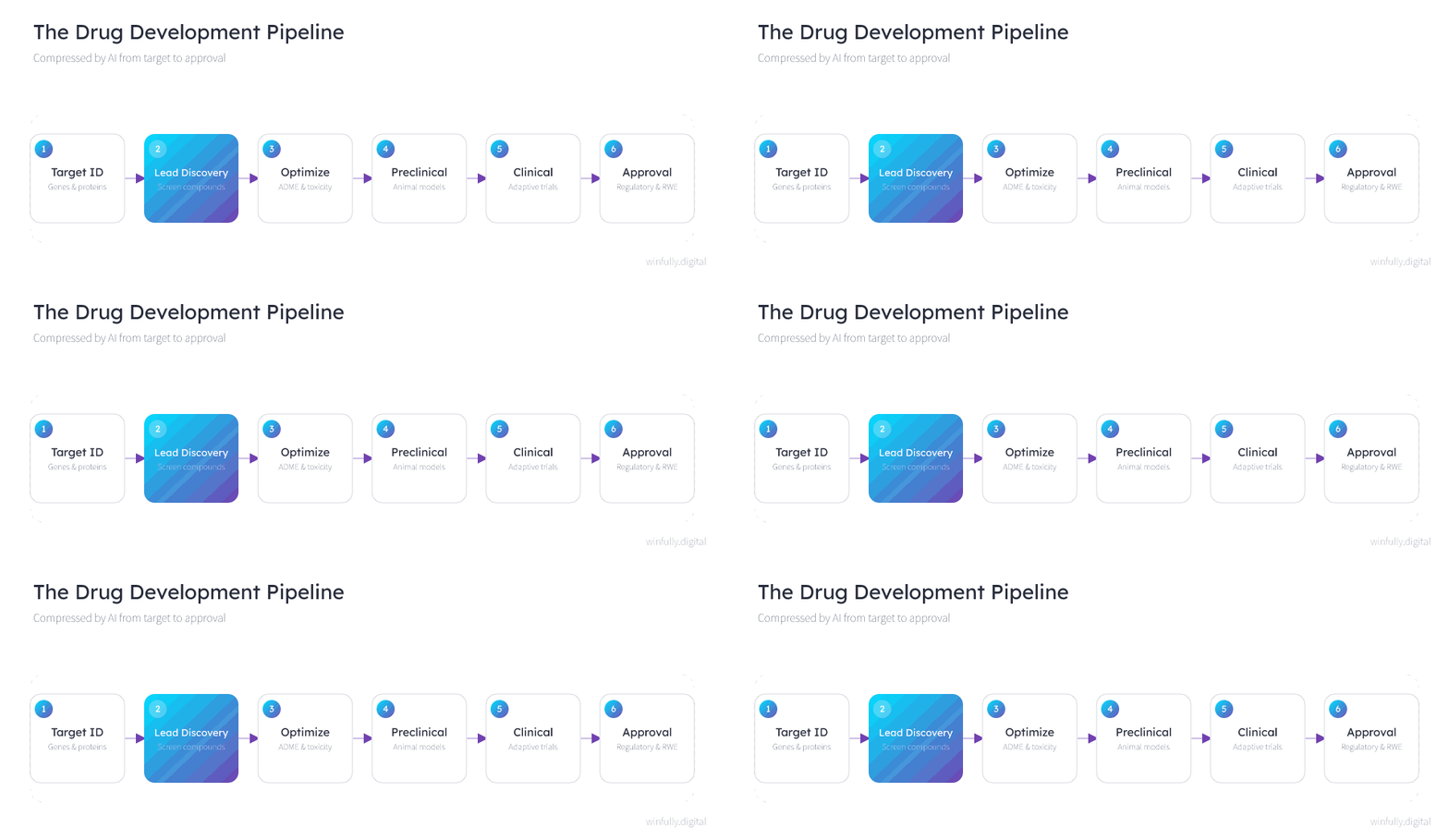
Cost Reduction Strategies Through AI/ML
A few concrete places where AI and ML take costs out of drug development:
-
Fewer trial failures: Better target selection and lead discovery mean fewer candidates collapsing in late stages. Each of those failures can burn tens or hundreds of millions of dollars.
-
Smaller, sharper trials: Adaptive designs and predictive analytics support leaner, better-aimed trials, which lowers recruitment and operational costs.
-
Operational efficiency: AI-guided automation and robotics take the manual grind out of repetitive lab and clinical tasks.
-
Data management: Cloud-based AI platforms handle massive datasets without the infrastructure bill of doing it in-house, and they scale.
-
Regulatory streamlining: Faster submissions and proactive safety monitoring cut compliance problems and the expensive delays they cause.
Together, these shave months or even years off the standard timeline. Earlier market entry and longer effective patent life both feed directly into ROI.
Key Considerations and Best Practices
If you lead a pharma or life science organization — as a CEO, CTO, CFO, Director of Operations, or VP of Operations — a few things separate AI programs that pay off from those that stall:
-
Data quality and integration: Models are only as good as what you feed them. Put money into data cleaning and governance so your systems run on reliable, well-connected data.
-
Talent and partnerships: This work needs cross-functional depth. Hire or partner with bioinformaticians, data scientists, chemoinformaticians, and IT consulting teams who know life science workflows.
-
Scalable infrastructure: AI workloads are compute-hungry. Weigh cloud and edge options for processing power, and make sure your infrastructure can carry the data volumes involved.
-
Regulatory strategy: Engage regulators early and document thoroughly. Be ready to show model validity and traceability.
-
Security and privacy: Sensitive clinical and patient data demands strong cybersecurity, and compliance with HIPAA, GDPR, and related rules is non-negotiable.
-
Pilot programs: Begin where the wins are clearest — compound screening or patient recruitment — then scale once the ROI is proven.
-
Change management: New tools ask for new habits. Invest in training and bring stakeholders along so teams adopt rather than resist.
The Future Outlook
AI, ML, and LLMs have moved past the add-on stage; they now drive how drug discovery advances. A few directions worth watching:
-
Precision medicine: As personalized therapies go mainstream, AI will help design drugs matched to individual genetic profiles, lifting treatment efficacy.
-
Gene editing: Tools like CRISPR will use ML to pin down off-target effects more precisely, making gene therapy safer.
-
Real-time regulatory oversight: Regulators are catching on to AI's potential and may adopt real-time data monitoring for faster, more responsive approvals.
-
Fully automated labs: The "Lab of the Future" points toward end-to-end automation — from compound design through in vivo testing — coordinated by AI.
The companies putting money into AI and LLMs now are the ones that will define the next wave of pharmaceutical breakthroughs. This is no longer a luxury; it is becoming a competitive necessity.
Conclusion
AI has changed drug discovery on every axis that matters: faster pipelines, lower costs, better success rates. From target identification through lead optimization, clinical trial management, and regulatory compliance, these tools take on the hardest problems life science and pharmaceutical organizations face.
For the leaders making the call — CEOs, CTOs, CFOs, Directors and VPs of Operations — the takeaway is simple. AI and LLMs are levers for operational efficiency and market position. Plan carefully around data governance, infrastructure, talent, and change management, and you get the full value of them.
Adopting these technologies now is not just about keeping pace. With the right strategy, investment, and partners, life science organizations can compress R&D timelines, get life-saving treatments to patients sooner, and strengthen the bottom line at the same time.
Key Takeaways
-
AI, ML, and LLMs deliver real time and cost benefits across drug development, from target identification through clinical trials and post-market surveillance.
-
The high costs and long timelines in pharma R&D respond to predictive modeling, virtual screening, automated workflows, and data-driven decisions.
-
Drug discovery is heading toward personalized medicine, real-time data monitoring, and fully automated labs, all driven by AI.
Put these technologies to work well, and the life science and pharmaceutical sector gets a faster, leaner, more cost-effective path to the medical breakthroughs that matter.